Q&A with Randy Moore, CEO, Quam Nichols
Networked audio is opening new possibilities for commercial AV, but for integrators, every new capability can also introduce another layer of complexity. More devices on the network mean more configuration, more coordination with IT and potentially more opportunities for something to slow down an installation.
Quam Nichols believes the answer isn’t more complexity. It’s making the endpoint simpler.
The nearly 100-year-old commercial loudspeaker manufacturer recently introduced QIP, a family of PoE/PoE+ network audio endpoints designed for SIP/Multicast and Singlewire InformaCast® environments. We spoke with Quam CEO Randy Moore about network audio from the integrator’s perspective—and why the next generation of audio technology still needs to solve some very old-fashioned problems.
Q: Integrators are being asked to deliver increasingly sophisticated systems with fewer resources and tighter timelines. How should manufacturers be responding?
Randy Moore: By remembering who has to install all of this.
It’s easy to keep adding features to a product. But every additional layer of complexity can translate into more time in the field, more training, more troubleshooting and potentially another truck roll.
Manufacturers need to look beyond what a product can do and ask how easily an integrator can actually deploy it.
That’s something we’ve always taken seriously at Quam. Our products are supposed to make an integrator’s job easier, not give them another problem to solve.
Q: Does moving audio onto the network make that challenge greater?
Moore: It certainly can.
The network gives integrators tremendous flexibility, but you’re also bringing together audio, networking, communications platforms and sometimes life-safety applications. The more systems that need to work together, the more important it becomes to eliminate unnecessary complexity wherever you can.
The endpoint should be one of the easy parts.
That was a major consideration when we developed QIP. We wanted integrators to be able to get the endpoint onto the network, configure it and move on with the project.
Q: Quam waited until now to enter the network-audio endpoint category. Was that intentional?
Moore: Very much so. We’ve never built our business around being first.
Quam has been making commercial audio products for nearly 100 years. You don’t stay in business that long by chasing every technology trend. You stay in business by understanding your customers and making products that solve real problems.
We watched network audio develop, listened to what integrators were experiencing and looked at where we could contribute something meaningful.
We weren’t interested in entering the category just to say we were there. We wanted to get it right.
Q: Where do you see the biggest opportunity for integrators with network audio?
Moore: Scalability is a big one.
Once audio becomes part of the network infrastructure, integrators have much more flexibility in how they design systems and expand them over time. A customer may start with paging and later want emergency notification, background music or additional communication capabilities.
That creates an opportunity for the integrator to build a longer-term relationship rather than treating audio as a one-and-done installation.
The system can grow with the customer.
Q: QIP launches with five different configurations. How does that help in the field?
Moore: It lets the application dictate the product instead of forcing the installation around the hardware.
A corporate office, school, healthcare facility or warehouse can have very different architectural conditions within the same project. You may have standard ceiling grids, hard ceilings and areas where wall mounting makes more sense.
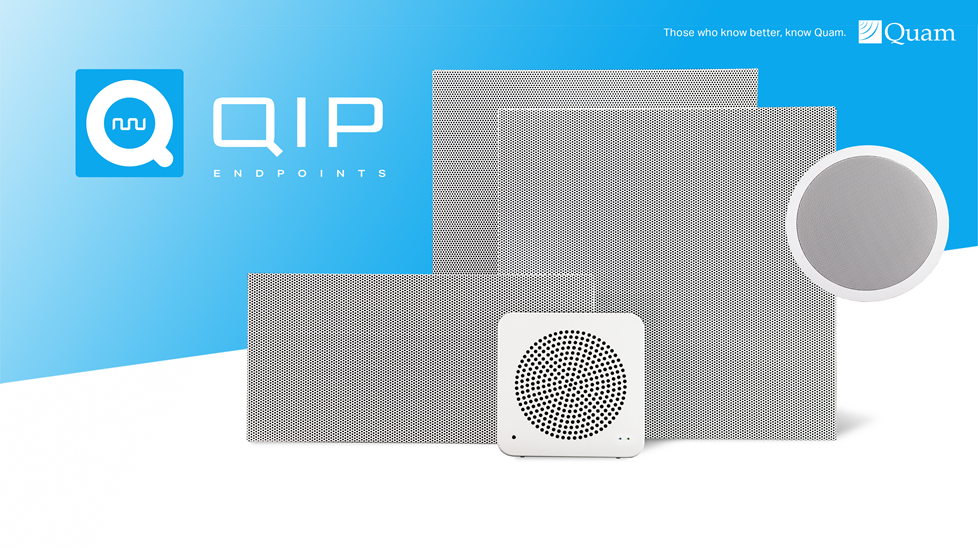
QIP gives integrators multiple options, including 1-by-2 and 2-by-2 tile replacement endpoints, a two-way 2-by-2 model, an all-in-one cut-in ceiling endpoint and a wall-mounted endpoint.
The goal is flexibility without reinventing the system every time the ceiling changes.
Q: How important is standardization as integrators take on larger or multisite deployments?
Moore: Extremely important.
If you’re deploying across dozens of rooms, buildings or locations, small inefficiencies become big inefficiencies very quickly.
Having repeatable products, predictable installation and centralized management can make a significant difference. That’s part of why we’re also supporting QIP with the Quam Endpoint Manager.
Integrators need tools that help them deploy and manage endpoints without creating a completely different workflow for every project.
Q: There’s also increasing overlap between AV and IT. What does that mean for the traditional AV integrator?
Moore: I think it’s an opportunity, but integrators have to be comfortable speaking both languages.
The customer doesn’t necessarily care whether something is considered AV, IT or communications infrastructure. They care that it works.
Network audio sits right in the middle of those worlds. Integrators who understand audio but can also work effectively with the customer’s IT team are in a strong position.
Manufacturers have a responsibility there, too. Products, documentation and technical support need to help bridge that gap rather than make it wider.
Q: What role does manufacturer support play as products become more network-centric?
Moore: A huge one.
You can’t hand an integrator a network product and a manual and tell them good luck.
When something doesn’t behave as expected in the field, the integrator needs access to someone who understands the product and can help solve the problem. That’s why dedicated technical support is an important part of the QIP ecosystem.
Technology can change. Good support shouldn’t.
Q: Quam is approaching its 100th anniversary. What hasn’t changed about what integrators need from manufacturers?
Moore: They need products they can trust.
They need equipment to show up, install the way it’s supposed to, perform the way it was specified and keep working after they leave the jobsite.
Network audio may be a new chapter for Quam, but those expectations aren’t new at all.
If we can combine what the network makes possible with the reliability and simplicity integrators have expected from us for generations, that’s a pretty good place for Quam to be heading into its next century.

Randy Moore is CEO of Quam-Nichols Company, a Chicago-based manufacturer of commercial loudspeakers and related audio products. Since 1930, Quam has designed and manufactured solutions for paging, sound masking, music, signaling, intercom, and vandal-resistant applications across commercial, healthcare, education, hospitality, retail, and justice environments. More than 95% of Quam products are made in Chicago.